Longevity Is Miami’s Newest Wellness Obsession & This Clinic Is All In

For a city that built much of its reputation on bottle service and bad decisions, Miami has become astonishingly committed to living a very, very, very long time.
Walk through Miami Beach on any given morning and you’ll find little evidence of last night’s rager. You’ll pass, instead, small parades of sunrise joggers logging their Zone 2 miles, people leaving workout classes with green juices in hand, and friends comparing notes on their various peptide protocols.
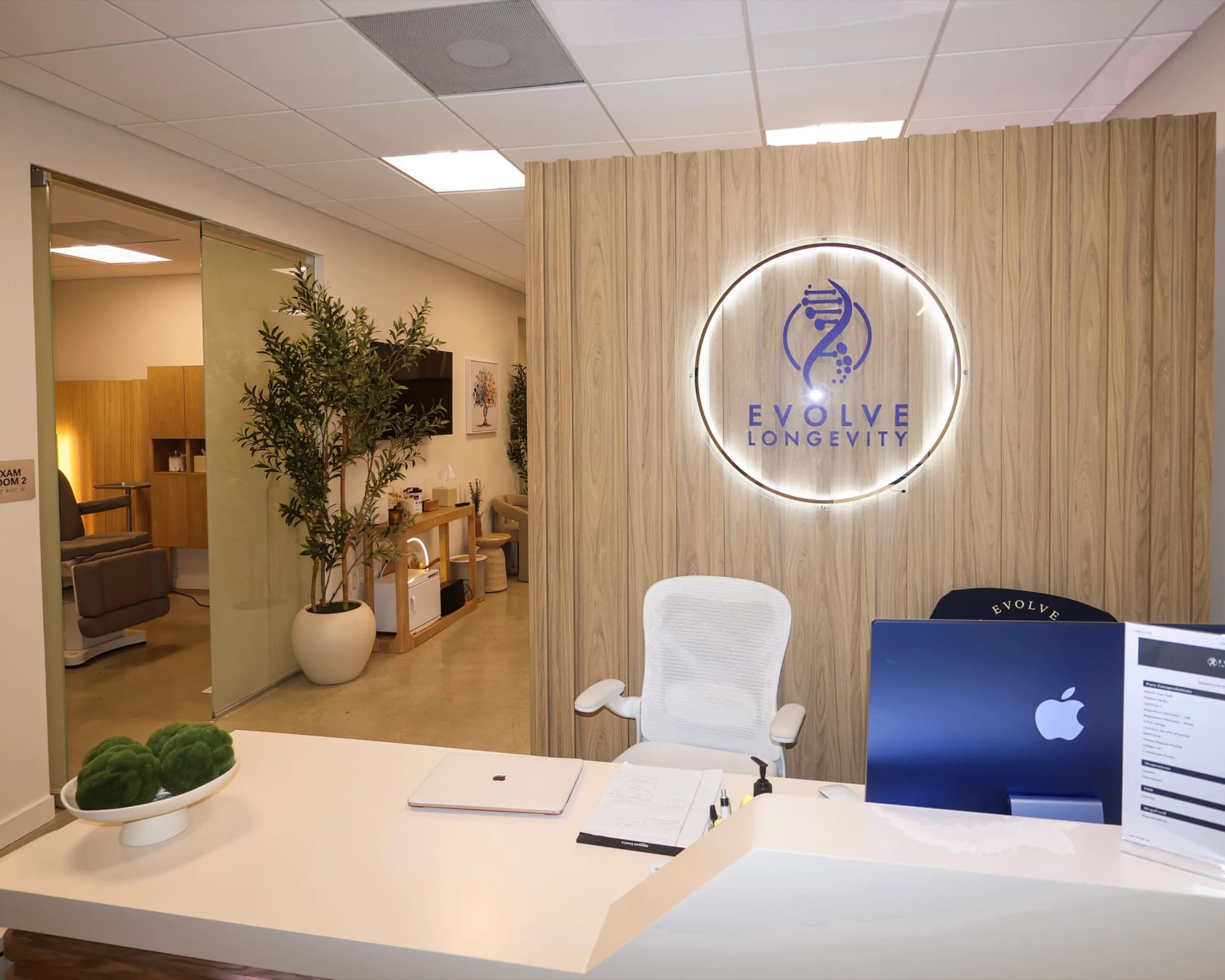
At some point, Miami transitioned into a wellness city, and Connor Wade took notice. The former Division I football player turned finance professional migrated here from New York during the pandemic after growing tired of the pace and the culture. Miami felt different. Health was becoming part of the city’s identity, and preventive medicine was inching its way from the fringes into the mainstream. Earlier this year, inspired by that shift, Wade founded Evolve Longevity, a physician-led longevity and regenerative medicine clinic in Miami Beach’s South of Fifth neighborhood, and now serves as its CEO.
At first glance, Evolve looks similar to the wellness clinics that have emerged over the past few years, offering everything from peptide therapy and lymphatic drainage to hyperbaric oxygen and IV infusions.
The difference, though, isn’t what’s on the menu (though Evolve certainly has its own approach there); it’s the driving question behind it all.
What If Healthcare Started Before You Got Sick?

For most of modern medicine, the relationship between patient and physician has followed a familiar script. Develop symptoms, make an appointment. A doctor identifies the problem, treatment begins. While it’s a great system for treating disease once it’s occurred, it’s way less effective at preventing it before it starts.
The gap between the years of feeling perfectly healthy and becoming undeniably ill is where longevity medicine has optimistically planted its flag.
“When COVID-19 happened, people began to realize that reactive medicine was backwards,” says Wade. “They wanted to start taking care of themselves before something happened.”
The idea isn’t complex. Exercise before you develop diabetes. Lower your cholesterol before you have a heart attack. Preserve muscle instead of trying to regain it at 70. Sleep before burnout turns chronic.
Putting it into practice, however, requires a deep dive into what’s actually happening inside your body.
Building the Baseline

Leading that work is Evolve’s medical team, headed by Medical Director Dr. Sam Zand, a double board-certified physician specializing in anti-aging, regenerative, and longevity medicine, and Director of Regenerative Medicine Dr. Gavin Ajami, whose multidisciplinary training spans internal medicine, physical medicine and rehabilitation, applied physiology, kinesiology, and public health. Alongside the clinic’s nursing staff, Zand and Ajami provide more than 30 hours of in-office physician access each week, with additional care available through telehealth.
For Evolve’s physicians, optimization begins with observation. Every test, scan, and data point offers another part of the picture, together forming the baseline that guides every recommendation that follows.
The process usually begins with bloodwork, and not the abbreviated panel most people receive during their annual physical. Depending on the patient’s goals and medical history, Evolve may order extensive lab testing to further evaluate cardiovascular health, metabolic function, hormone levels, inflammation, and other biomarkers that help show how the body is functioning. From there, testing becomes more and more individualized.
A DEXA scan, for example, is considered the gold standard for measuring body composition. It distinguishes between muscle, fat, bone density, and visceral fat (the metabolically active fat wrapped around internal organs that’s associated with increased cardiovascular risk).
VO₂ max measures how efficiently your body uses oxygen during exercise. Research consistently links higher cardiorespiratory fitness with lower rates of cardiovascular disease and all-cause mortality. In many circles, your VO₂ max is thought to be your strongest predictor of long-term health.
Depending on the patient, this workup may expand to include genetic testing, gut microbiome analysis, epigenetic testing, and biological age assessments, each helping physicians tailor recommendations to the patient without relying only on population averages.
For patients considering therapies that stimulate growth factors—certain peptides, for example—the evaluation often becomes even more comprehensive.
Dr. Ajami frequently recommends advanced cancer screening through the Galleri blood test or a Prenuvo whole-body MRI before treatment begins. “If you’re increasing growth factors,” he explains, “you want to make sure you’re not helping something else grow.”
Sometimes, the right prescription ends up being different from what was expected. Sometimes, there’s no prescription at all.
The Clinic That Says “No”

There’s an obvious tension at the center of longevity medicine. The same clinic responsible for deciding whether you need an expensive treatment is often the same one selling it to you.
At Evolve, much of this decision-making rests with Dr. Zand and Dr. Ajami, who, according to Wade, are more than comfortable turning business away. That might mean declining to prescribe a GLP-1 to a 100-pound person who wants to lose another five pounds, something Wade says happens more often than you’d think. It might mean holding off on a regenerative procedure until additional testing has ruled out bigger concerns. Or it might simply mean telling a patient that the treatment they came in asking for isn’t likely to do what they hope it will.
For Dr. Ajami, that restraint is part of the job.
“I pride myself on being a very honest practitioner,” he says. “A lot of times, I tell people not to do a treatment.”
His goal isn’t to squeeze as many therapies as possible into a patient’s plan, but to figure out which interventions are actually worth their time and money, as well as when and if they’re worth doing.
“We’re not interested in upselling patients,” Ajami says. “We’re interested in building longevity of care.”
That longer-term relationship is also reflected in how Evolve structures its care. Patients can book services à la carte or join one of the clinic’s annual membership programs, which range from $6,000 to $25,000 depending on the level of physician access, included treatments, and other benefits.
Membership also extends beyond Evolve’s walls. Through the clinic’s partnership with Kinesis MD, Ajami’s concierge functional and sports medicine practice, members receive quarterly consultations focused on their labs, functional health, and ongoing medical needs.
Regenerative Medicine, Functional Medicine, and Longevity Medicine—What’s the Difference?

“Regenerative medicine treats the past. Functional medicine treats the present. Longevity medicine treats the future,” says Dr. Ajami.
Regenerative medicine focuses on repairing damaged tissue. Someone recovering from a tendon injury or chronic shoulder pain may be a candidate for treatments such as platelet-rich plasma (PRP), stem cells, or focused shockwave therapy—all designed to encourage the body’s natural healing processes rather than simply masking pain.
Functional medicine asks why someone feels unwell in the first place. It looks closely at hormones, nutrition, sleep, gut health, inflammation, metabolic dysfunction, and micronutrient deficiencies to help put together the puzzle of what’s going on in this moment.
Longevity medicine shifts the timeline forward. Rather than asking, “How do we treat disease?” it asks, “How do we delay it?”
The Toolbox of Longevity

Put all three disciplines under one roof, and the resulting toolbox is extensive. Some of what you’ll find here has been used in medicine for decades, and some is only now beginning to find its place in the conversation. Here’s what it all actually does.
Peptide Therapy
Perhaps no treatment has generated more attention recently than peptide therapy.
Peptides are short chains of amino acids that act as signaling molecules, telling cells throughout the body when to repair tissue, release hormones, regulate appetite, or perform countless other biological tasks. Many peptide therapies work by essentially turning up the volume on signals your body already knows how to send.
Depending on the patient’s goals, physicians may recommend peptides that support weight management, muscle recovery, tissue repair, skin health, or metabolic function.
Wade has tried many of them himself. He uses tesamorelin to help reduce visceral fat, MOTS-c for mitochondrial health and metabolism, BPC-157 and TB-500 during injury recovery, and GHK-Cu for skin, hair, and nail health. But he’s quick to add an important disclaimer.
“The fundamentals are still the most important things,” he says. “Good sleep. Movement. Nutrition. Everything we do here is meant to enhance and optimize. You can’t just jab yourself and expect to be healthier.”
That ethos is loud throughout the clinic. Treatments here are presented as tools, not shortcuts.
Regenerative Medicine
Regenerative medicine focuses on repair. Treatments such as platelet-rich plasma (PRP) and stem cell therapy are designed to encourage the body’s own healing processes after injury or degeneration.
For Wade, regenerative medicine became personal after a weightlifting injury tore his AC joint. Rather than giving up weightlifting, he underwent a combination of stem cell treatments, PRP, shockwave therapy, and rehabilitation, all to great success.
“The coolest part of running this clinic is getting to use the treatments myself,” he says. “Being a firsthand user gives me a completely different perspective.”
That willingness to become, in his words, “patient number one” influences the clinic’s approach to new therapies.
“If I’m not doing it, feeling good and believing in it,” he says, “we’re not selling it.”
Shockwave Therapy
Focused shockwave therapy delivers high-energy acoustic waves deep into injured tissue.
“The goal is to create what’s called cavitation,” explains Dr. Ajami. Those sound waves generate microscopic bubbles within tissue. As the bubbles collapse, they create tiny mechanical forces that stimulate the release of growth factors and initiate what physicians call a healing cascade.
“It’s waking up the body’s innate healing capacity,” he says. The treatment is commonly used for chronic tendon injuries, plantar fasciitis, shoulder pain, tennis elbow, and other musculoskeletal conditions that can be slow to heal because of limited blood supply.
PEMF
PEMF, or pulsed electromagnetic field therapy, exposes the body to controlled electromagnetic fields.
According to Dr. Ajami, those fields repeatedly depolarize and repolarize nerve and muscle cells, helping improve communication between the nervous system and the muscles while also stimulating the release of growth factors involved in tissue repair.
It’s often incorporated into rehabilitation programs, particularly for patients recovering from injury or dealing with chronic pain.
Hyperbaric Oxygen Therapy
Patients receiving hyperbaric oxygen therapy spend about an hour inside a pressurized chamber breathing nearly pure oxygen. Under increased atmospheric pressure, oxygen dissolves more readily into the bloodstream, allowing it to reach tissues that might otherwise receive a limited supply.
The therapy has long been used in hospitals for conditions such as difficult-to-heal wounds and decompression sickness. Longevity clinics increasingly use it to support recovery, tissue repair, and athletic performance, though the strength of evidence varies depending on the condition being treated.
EBOO
The clinic’s most unusual offering might be extracorporeal blood oxygenation and ozonation, better known as EBOO.
During an EBOO session, blood circulates outside the body through a specialized filtration system before being exposed to medical ozone and passed under ultraviolet light prior to being returned to circulation. Dr. Ajami describes it as hitting “reset.”
After the treatment, he often follows with an infusion containing nicotinamide riboside, a precursor to NAD+, along with other regenerative therapies.
“The body has been cleaned,” he says. “It’s a clean slate, and it’s a perfect time to introduce something regenerative.”
EBOO remains one of the newer and more debated therapies in longevity medicine. While proponents believe it may support circulation and reduce oxidative stress, large, high-quality clinical trials remain limited, leaving it an area that still needs more research.
In the End, It’s About Playing the Long Game

For all the sophisticated testing, therapies, and technology inside Evolve, the advice always circles back to ordinary things. Move your body, eat well, sleep enough, and take care of yourself consistently.
Dr. Ajami says the clinic isn’t for people looking to outsource their health.
“If someone comes to me and they’re not moving and making an effort to take care of themselves,” he says, “this is not the clinic for them. This is an optimization clinic.”
No one has figured out how to live forever (great business opportunity). The meaningful pursuit here is about extending the portion of life in which we’re healthy enough to fully live it.
For Wade, that realization became deeply personal after losing his father. “I want to keep people around longer,” he says. “I want to keep my mom around longer.”
Strip away the tools and the machines, and that’s the ambition at the heart of Evolve—helping people spend more healthy years with the people they love.
Evolve Longevity is located at 555 Washington Ave., Suite 260, Miami Beach, FL 33139. Phone: 645-220-0575. For more information, visit their official website.

Ana Heretoiu is a freelance writer/brand copywriter based in Miami. Over the last 8 years she has covered hospitality, fashion, art & wellness in both editorial and advertorial capacity. Her former stints include being an editor for Eater Miami and contributor for several print and digital publications, including Ocean Drive Magazine, Modern Luxury, Think Magazine, Racked & Dining Out. Aside from writing, Ana enjoys teaching Yoga, getting in and out of the twistiest of shapes, and inventing new words, like “twistiest.”
View all posts →